Branco Weiss Fellow Since
2026
Research Category
Origins of life, biophysics, RNA biochemistry, geochemistry
Research Location
École Polytechnique Paris, France
Background
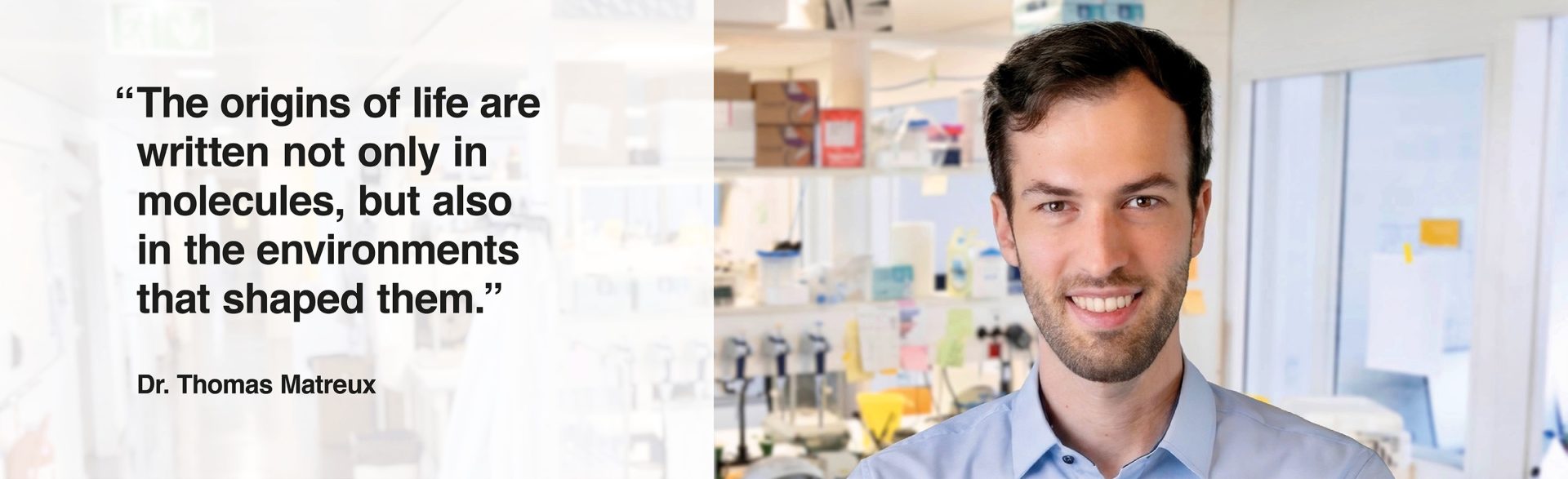
How did life emerge from non-living matter? Although decades of research have revealed plausible pathways for the formation of life’s building blocks, a fundamental puzzle remains unresolved: functional molecules capable of catalysis are extraordinarily rare among the vast number of possible molecular structures. The challenge is therefore not only how molecules formed, but also how certain structures became preferentially enriched before the onset of biological evolution began. The “RNA world” hypothesis proposes that RNA preceded modern DNA and proteins as both an information carrier and a catalyst. Yet, catalytic RNAs are scarce among random sequences, and their identification typically is done by using large libraries and modern laboratory techniques. Thomas Matreux approaches the problem from a different angle. Rather than focusing on the molecules themselves, he investigates how physical environments may have acted as selectors, favouring certain molecular structures long before biological evolution began.
Details of Research
Thomas Matreux studies how mineral surfaces, rocks, clays, and phase-separated molecular compartments interact with RNA populations. His central hypothesis is that these environments imposed structure-dependent selection pressures on RNA, enriching some molecular folds while excluding others. Such biases may have profoundly influenced which biological functions became accessible during the earliest stages of evolution. To investigate this question, he develops experimentally traceable libraries of structurally diverse RNA molecules and combines them with advanced sequencing, computational modelling and laboratory evolution techniques. By exposing these RNA populations to different geological and physicochemical environments, he can observe how environmental conditions reshape molecular diversity and affect the emergence of catalytic activity. His work builds on a series of influential studies demonstrating how geothermal heat flows and mineral environments can enrich and separate prebiotic molecules and establish local reaction niches. Ultimately, he aims to identify general principles linking physical environments, molecular structure, and evolutionary potential. Such principles may not only improve our understanding of life’s origins on Earth but also inform the search for life elsewhere in the universe and inspire new approaches in biotechnology and molecular engineering.